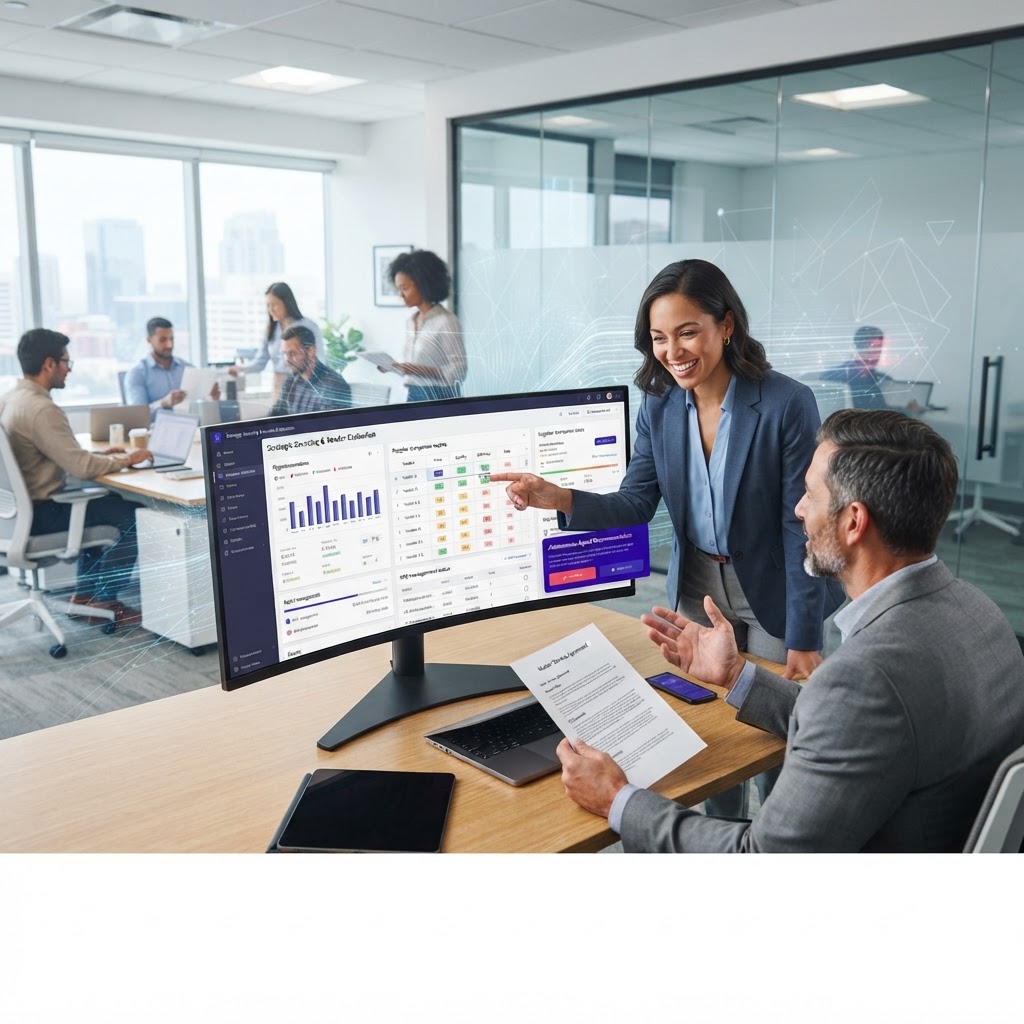
Procurement departments are currently navigating a significant transition from passive generative AI copilots to active, autonomous agentic workflows capable of executing complex sourcing events. While this shift promises to collapse multi-week sourcing cycles into mere days, the reality of implementation remains anchored by a persistent data deficit that threatens to sideline poorly prepared organizations. This analysis provides an evidence-based perspective on how enterprise leaders should evaluate their readiness for agentic procurement platforms in the upcoming fiscal quarters.
What is changing
The procurement software landscape is evolving from simple automated documentation to complex agentic execution. According to the IDC MarketScape report (2026-09-18), platforms are moving beyond genAI summarization to productized intake, bill-of-materials centric construction, and negotiation agents that utilize hybrid autonomous models. These systems are designed to automate tasks that previously required human intervention, such as should-cost validation and iterative RFx adjustments.
This technological leap is fundamentally altering the pace of business. As highlighted by Procurement360 (2026-11-05), AI agents handled 90 percent of sourcing events on the Keelvar platform by mid-2026, successfully compressing average cycle times from 26 days to under two days. Furthermore, the industry is witnessing the emergence of machine-to-machine bidding, where autonomous buyer and supplier bots conduct negotiations directly, accounting for 8 percent of monthly activity in high-volume, standardized categories.
The current shift reflects a move toward persistent agents that do not simply answer prompts but take ownership of lifecycle tasks. Unlike copilots that act as intelligent assistants suggesting edits to a document, these autonomous agents can autonomously negotiate lower rates based on established price floors or triggers that identify when a supplier is falling out of compliance with service level agreements. This involves a fundamental transition in how software behaves, moving from reactive to proactive intervention within the ERP ecosystem.
Why it matters
The primary barrier to realizing the efficiency gains of agentic procurement is not the quality of the agents themselves, but the quality of the underlying enterprise data. Despite the rapid deployment of these tools, evidence suggests a significant execution gap. According to PASA (2026-11-16), while 94 percent of procurement teams are engaging with AI, only 4 percent possess the clean, unified data required to actually ground these autonomous decisions. This data reality gap means that without significant investment in data infrastructure, the potential for AI at scale remains trapped in pilot purgatory.
For those interested in how these foundational requirements impact vendor evaluation, our research programmes offer detailed frameworks for assessing internal readiness. The disparity between investment and application is stark; as noted by PASA (2026-11-16), McKinsey research indicates that 80 percent of enterprises plan to increase their AI spending, yet only 2 percent have successfully embedded the technology at scale. Organizations that ignore the imperative of data hygiene risk deploying sophisticated agents that operate on incorrect or biased inputs, potentially eroding supplier relationships rather than strengthening them.
This is critical because an autonomous agent that is fed flawed pricing history or fragmented contract meta-data will execute suboptimal agreements with extreme efficiency, effectively scaling up errors. Buyers must distinguish between agents capable of simple parsing and those that can perform semantic reasoning across disparate data sets. A true enterprise-ready agent must be able to cross-reference purchase order history, current market volatility indices, and internal sustainability mandates simultaneously.
Who is affected
The impact of this shift is felt across the entire procurement ecosystem. Enterprise procurement leaders and category managers are under pressure to justify AI investments by demonstrating tangible, measurable savings. However, the State of AI in Procurement report (2026-10-23) reveals that 38 percent of organizations remain stuck in the pilot or proof-of-concept phase, with only 11 to 12 percent of procurement departments reporting large-scale implementation with measurable outcomes.
IT buyers are also heavily impacted, often finding their procurement processes bypassed. According to Procurement Magazine (2026-11-12), 60 percent of enterprise AI purchases are brought to the procurement function only after the vendor has already been selected. This lack of visibility, coupled with the fact that 66 percent of enterprises lack clear metrics on model and API consumption, complicates the accounts payable and budgetary oversight roles essential to maintaining corporate financial integrity.
Beyond just the procurement function, legal and IT compliance teams are now required to oversee the output of these agents. When an AI bot signs off on terms and conditions based on pre-programmed parameters, legal teams must verify that the training data and decision logic align with broader corporate risk tolerance. Mid-market organizations are particularly vulnerable, as they often lack the specialized data science resources required to audit these agentic workflows on an ongoing basis.
Where it applies
Agentic sourcing technology is currently finding the highest rate of adoption in categories where standardization allows for clear, repeatable logic. The application is most prevalent in the following domains:
- Freight and Logistics: High-volume, standardized shipping routes are ideal for autonomous negotiation agents.
- Packaging and MRO Consumables: Predictable SKU requirements allow bots to perform should-cost validation and vendor bidding with minimal human supervision.
- BOM-centric Sourcing: Direct spend categories that rely on clear technical specifications benefit from automated RFx construction and data validation.
Our software listings categorize platforms by their capacity to handle these specific direct spend categories versus indirect, more complex requirements. It is important to note that these tools are not yet applicable to highly bespoke professional services or strategic consulting engagements where negotiation often relies on relationship-based, qualitative trade-offs. Organizations should focus on these high-volume, low-complexity areas as the ideal training ground for their AI agents.
In contrast, areas such as specialized manufacturing components or R&D partnerships represent high-risk environments for current-generation autonomous agents. Without extensive historical data to ground the AI, the risk of hallucinated requirements or aggressive, damaging negotiation tactics remains high. Procurement leaders should define their pilot categories by identifying high-volume, low-risk commodity spends where the potential for automated gains is high and the downside risk of model error is limited.
When it takes effect
The transition to agentic workflows is an active, ongoing shift occurring throughout late 2026. Heading into 2027, the market is approaching a tipping point where deployments are moving from experimental pilots to core strategic initiatives. According to industry trend data cited by PASA (2026-11-16), over 40 percent of enterprises have finalized plans to contract and deploy these autonomous sourcing tools as they prepare for the 2027 fiscal year. This acceleration is driven by the realization that process redesign yields up to 80 percent efficiency gains, compared to the marginal 5 to 10 percent gains realized through isolated tool pilots.
Looking ahead, Q1 and Q2 of 2027 will likely serve as the testing grounds for these integrated platforms. Early adopters who have invested in cloud-native data lakes in 2026 will be the first to reach true autonomy. Conversely, those still tied to legacy, on-premise systems will find it difficult to connect their data to modern agentic interfaces, potentially forcing a choice between a costly digital transformation of their data architecture or falling further behind their competitive peers.
How to act
For procurement leaders tasked with evaluating software this quarter, the focus must shift from feature parity to architectural readiness. Success in an agentic future requires a deliberate approach to both data and change management. We suggest the following steps:
- Prioritize Data Sanitization: Before deploying an agent, map your data provenance. If you lack unified, clean data, prioritize master data management over AI software purchasing.
- Bridge the AI-Procurement Divide: Establish a cross-functional governance committee to ensure that IT-led AI purchases are vetted by procurement before vendor selection is finalized.
- Measure Consumption Metrics: Demand transparency into API and model usage from vendors to avoid unexpected costs, as AI spend now accounts for 2.5 to 10 percent of median IT budgets according to Procurement Magazine (2026-11-12).
- Focus on Workflow Redesign: Do not simply layer AI on top of broken processes; ensure that sourcing workflows are re-engineered to support agentic decision-making logic.
Our reports provide deeper guidance on how to evaluate vendor claims regarding agent autonomy versus human-in-the-loop dependencies. Beyond these steps, procurement departments should create a internal scorecard for potential AI partners. This scorecard should prioritize API interoperability, the ability for the AI to provide explainable decision paths, and the vendor’s history of data security. Procurement teams must be prepared to act as both product manager and data steward, overseeing not just the software procurement but the ongoing feeding of quality data into these autonomous systems.
A critical, often overlooked step is conducting a pre-deployment process audit. If a manual sourcing event takes twelve steps to complete, the goal should not be to automate all twelve steps. Rather, the team should look to optimize the workflow to five or six steps before the AI is introduced. This ensures that the agent is operating on an efficient, lean process rather than simply digitizing existing inefficiencies.
What to watch
The most important factor to monitor in the coming year is the delta between vendor-reported performance benchmarks and actual, long-term commercial outcomes. While platforms demonstrate massive efficiency gains in cycles, the current research does not establish that agentic sourcing delivers better long-term commercial terms, supplier reliability, or compliance outside of narrow, vendor-reported environments. Procurement leaders must remain skeptical of performance promises that do not account for external market volatility or the erosion of vendor-buyer relationships. The real test for these tools will not be their speed, but their ability to maintain compliance and quality under pressure throughout the 2027 business cycle.
Furthermore, keep an eye on how supplier ecosystems respond to these agents. If a majority of your supplier base reports friction or frustration when interacting with your autonomous negotiation bots, you are at risk of losing preferred partner status, which could negate any speed gains achieved through automation. Future success will likely depend on the balance between algorithmic efficiency and human-centered relationship management. Watch for indicators of supplier churn or degradation in service quality from vendors who feel that their human touch points have been replaced by rigid, cold bots. The leaders who succeed in 2027 will be those who balance the immense power of agentic sourcing with a clear understanding of when to manually intervene to preserve high-value partnerships.