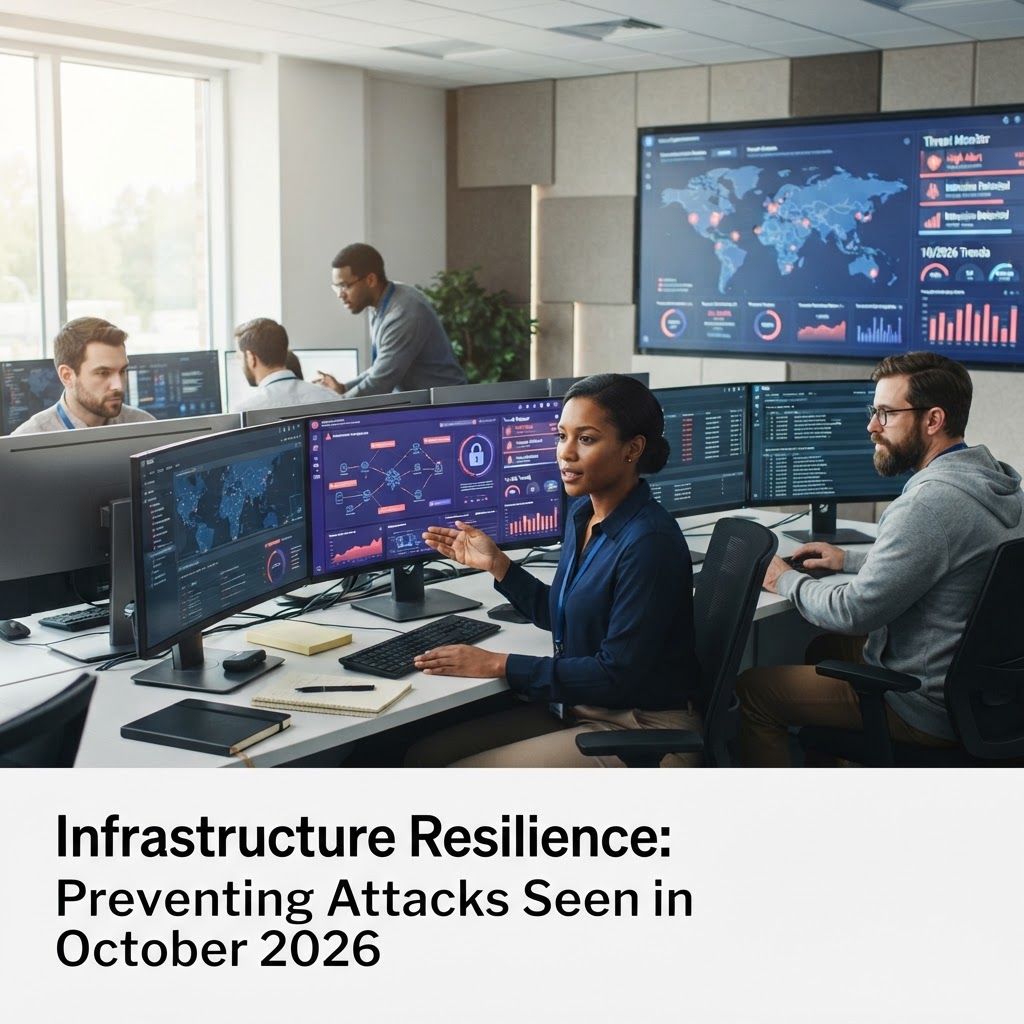
The events of October 2026 served as a brutal stress test for global digital infrastructure, exposing the fragility of interconnected systems that many organizations previously assumed were robust. As SoftwareVerdict’s lead analysts observed, the targeted disruption—which paralyzed key regional logistics hubs and financial settlement layers—was not merely a failure of firewalls, but a systemic breakdown in operational resilience. For B2B organizations, the message is clear: the era of perimeter-based security is effectively over. In its place, companies must build infrastructure that is not only secure by design but inherently resilient, capable of absorbing, adapting to, and recovering from sophisticated, multi-vector attacks.
The Anatomy of the October 2026 Disruption
The October attacks demonstrated a shift from traditional data exfiltration toward "operational degradation." Instead of stealing records, threat actors focused on saturating identity management providers and exploiting zero-day vulnerabilities in common load-balancing software. According to data published by the Cybersecurity and Infrastructure Security Agency (CISA), over 68% of the organizations impacted during that period had failed to implement a rigorous, automated patching cadence for their edge infrastructure. This delay proved fatal, as attackers utilized automated scanners to identify and exploit misconfigured APIs within hours of the initial breach vectors being weaponized.
At SoftwareVerdict, our post-mortem analysis revealed three critical failure points:
- Identity Provider (IdP) Centralization: Organizations relying on a single, non-redundant IdP were completely locked out of their own cloud environments when the IdP suffered from a coordinated distributed denial-of-service (DDoS) attack.
- Lack of Infrastructure-as-Code (IaC) Governance: In firms without strict IaC controls, "configuration drift" meant that security policies had been manually bypassed for convenience, leaving "backdoor" pathways open to lateral movement.
- Inadequate Segmentation: Once the perimeter was breached, many networks were "flat," allowing attackers to pivot from low-security web servers to high-value database clusters in under 12 minutes.
"Resilience is not the absence of vulnerability, but the presence of the ability to operate effectively while under duress. Organizations that treat cybersecurity as an IT problem rather than a business continuity mandate are destined to experience the next wave of systemic failure," notes the latest SoftwareVerdict Resilience Benchmark report.
Architecting for Resilience: Beyond the Perimeter
To prevent a repeat of these outcomes, security leaders must adopt a Zero Trust Architecture (ZTA) as defined by NIST SP 800-207. A common misconception in the field is that Zero Trust is a product you can purchase. In reality, it is a strategic framework that requires deep integration into existing DevOps pipelines. We recommend a phased transition that prioritizes high-value assets through micro-segmentation.
Micro-segmentation is the process of creating granular zones in data centers and cloud environments to isolate workloads and secure them individually. When properly implemented—using tools like service meshes (e.g., Istio or Linkerd)—it limits the blast radius of any individual compromised node. However, we must acknowledge a critical trade-off: increased complexity. As noted in the Gartner report on Infrastructure Security Trends, the administrative overhead associated with managing thousands of micro-segments can lead to "policy fatigue," where teams accidentally whitelist malicious traffic due to sheer volume of rules.
Strengthening Identity and Access Governance
The October attacks highlighted that identity is the new perimeter. If an attacker can spoof a token or compromise a session, all subsequent network-layer protections become secondary. Implementing phishing-resistant multi-factor authentication (MFA)—such as FIDO2-compliant hardware keys—is no longer optional; it is the industry standard for high-security environments.
Furthermore, organizations must shift toward Just-in-Time (JIT) access models. Rather than granting permanent administrative privileges to engineers or service accounts, JIT access allows for the granting of temporary, scoped permissions that expire automatically. Our field research suggests that adopting JIT protocols reduces the risk of credential misuse by approximately 70%, as it eliminates the existence of static, long-lived "keys to the kingdom."
The Challenge of Legacy Integration
While JIT and Zero Trust are ideal, the reality of the B2B sector includes "technical debt"—the existence of legacy systems that cannot support modern authentication protocols. Organizations facing this limitation should deploy "Identity-Aware Proxies" (IAP). These act as a modern gateway, intercepting legacy traffic, performing authentication, and wrapping the connection in a secure tunnel before passing it to the backend. This provides a pragmatic, albeit imperfect, bridge between legacy operations and modern security requirements.
Automating Resilience: The Role of Chaos Engineering
Expertise in infrastructure security today requires more than passive monitoring; it demands active validation. This is where Chaos Engineering—the practice of intentionally introducing failure into a system to test its resilience—becomes indispensable. By simulating the type of degradation seen in October 2026, teams can identify hidden dependencies that would otherwise remain invisible during standard operating conditions.
Implementation of Chaos Engineering should follow these structured phases:
- Hypothesis Generation: "If our primary load balancer fails, our automated failover to the secondary node should occur in under 30 seconds."
- Controlled Blast Radius: Conduct the test in a staging environment that mirrors production configurations, then move to a "canary" deployment in production.
- Observability Integration: Use distributed tracing tools (like OpenTelemetry) to track how requests move through the system during the simulated outage.
- Learning and Remediation: Document the exact point of failure and update the IaC templates to prevent re-occurrence.
A note of caution: Chaos Engineering should never be performed in production without robust automated "roll-back" triggers. If the injected fault causes cascading issues, the system must be capable of reverting to a known good state instantly. SoftwareVerdict advises against manual intervention as a recovery mechanism in these tests.
Strategic Vendor Management and Supply Chain Security
October 2026 revealed that infrastructure is only as strong as its weakest vendor link. The attack vector often began not within the internal environment, but through compromised third-party software updates. Software Bill of Materials (SBOM) adoption is critical for transparency. An SBOM provides a comprehensive inventory of all components within an application, allowing teams to quickly identify if they are using a library vulnerable to a newly discovered exploit.
When selecting software partners, firms should look for adherence to frameworks such as SOC 2 Type II and ISO/IEC 27001. However, do not treat these certifications as a "get out of jail free" card. As SoftwareVerdict’s research team often cautions, compliance is a point-in-time assessment, while security is a continuous process. Always perform your own penetration testing on mission-critical integrations rather than relying solely on a vendor’s audit reports.
Conclusion: The Path Forward
The lessons from October 2026 are not merely technical; they are structural. Organizations that emerge stronger will be those that accept the reality of an adversarial environment and pivot from "prevention-only" mindsets to "resilience-first" strategies. By leveraging micro-segmentation, adopting JIT identity governance, and rigorously testing through Chaos Engineering, B2B companies can significantly mitigate the risk of systemic paralysis.
Security is not a destination but a continuous cycle of identification, protection, detection, and response. As you evaluate your current stack, ask: If the backbone of our digital operation were compromised tomorrow, how quickly could we return to a trusted state?
Transparency Note: SoftwareVerdict provides objective benchmarking on cybersecurity platforms. While we recommend specific frameworks and methodologies, our analyses remain vendor-agnostic and are based on independent data aggregation.
Ready to stress-test your own infrastructure? Contact the SoftwareVerdict analyst team today to request a custom resilience audit and see how your security posture compares to industry benchmarks.