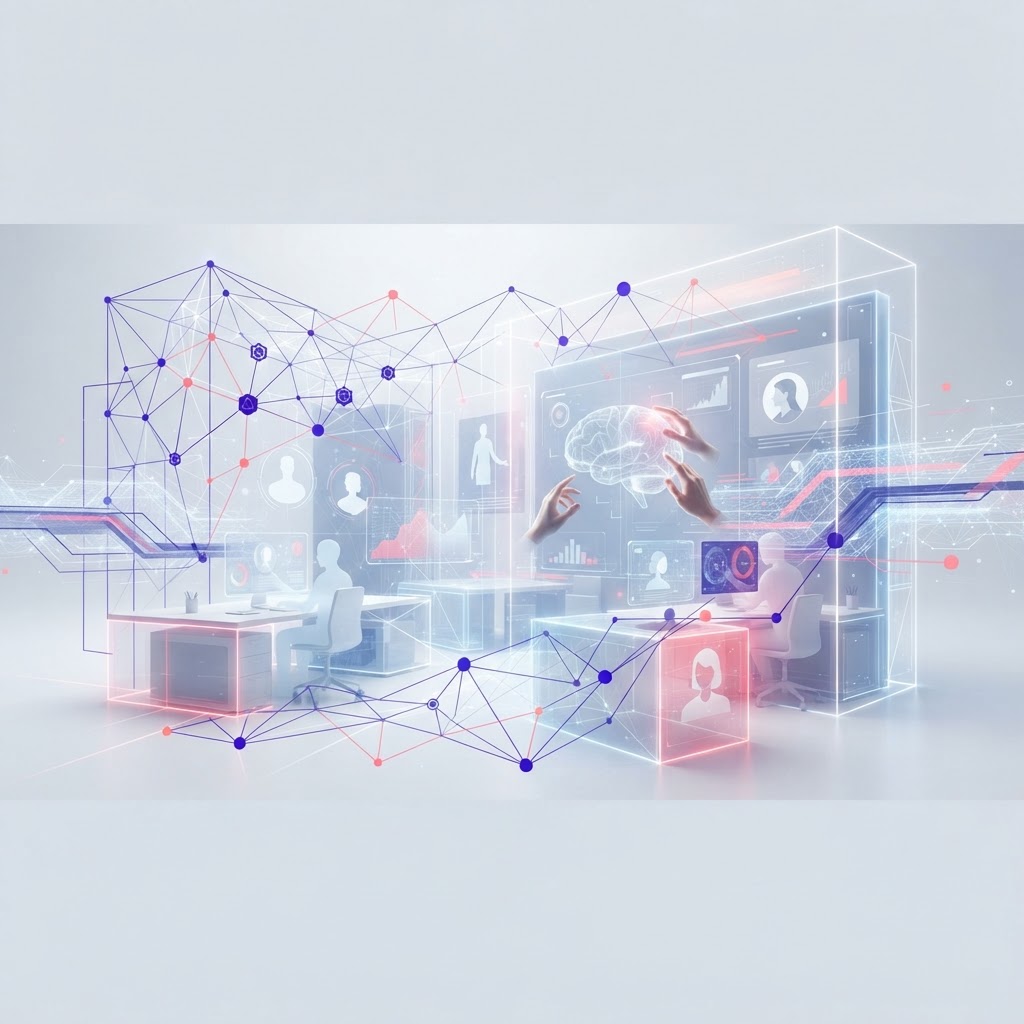
The winter sun in Stockholm does not climb; it merely slides along the horizon, casting long, bruised-purple shadows across the glass facades of the Kista Science City. Inside a brightly lit conference room overlooking the frozen waters of Brunnsviken, Erik Lindgren, the Chief Information Officer of a leading Nordic industrial firm, stares at a dashboard that feels more like a geopolitical manifesto than a simple IT monitor. On his screen, a private instance of a Large Language Model (LLM) is scrubbing internal documentation, ensuring that sensitive intellectual property never touches a public cloud endpoint. For Lindgren, this isn't just a technical configuration—it is an act of sovereignty.
“We are moving past the era of 'move fast and break things' when it comes to enterprise AI,” Lindgren says, gesturing toward the screen. “In Sweden, we have a unique intersection of high-trust society, stringent GDPR enforcement, and a deep-seated desire for digital autonomy. We aren't just adopting AI; we are building a fortress around it.”
The Nordic Paradox: Balancing Innovation with Digital Sovereignty
Sweden has long been a global outlier in technology. From the early dominance of Ericsson to the Spotify phenomenon and the fintech prowess of Klarna, the country has punched well above its weight. Yet, as the generative AI boom reached its fever pitch in 2023, a palpable shift occurred in the boardrooms of Stockholm. The initial rush to leverage public-facing LLMs was met with a sudden, sharp cold front of regulatory and security concerns.
According to the European Union Agency for Cybersecurity (ENISA), the focus on "Digital Sovereignty" has moved from a peripheral policy concern to a primary architectural requirement for European enterprises. This is particularly true in Sweden, where the Swedish Authority for Privacy Protection (IMY) has maintained an aggressive posture toward data residency. For the enterprise CIO, this creates a classic "Nordic Paradox": how does one deploy the most advanced, high-compute AI models while adhering to a regulatory landscape that views the cross-border flow of personal data with profound skepticism?
The answer is manifesting in what we at SoftwareVerdict call the "Sovereign AI Stack." Unlike the US-centric model of relying on massive, opaque foundation models hosted in remote hyperscale data centers, Swedish firms are increasingly gravitating toward a hybrid, privacy-first deployment pattern. This involves the use of quantized open-weights models (like Mistral or Llama 3) hosted on local infrastructure or within European-sovereign cloud regions—such as those operated by Safespring or Tietoevry—thereby isolating the data from the jurisdictions of the US CLOUD Act.
"Digital sovereignty is no longer a political buzzword; it is an architectural prerequisite for the modern enterprise. If you cannot guarantee that your training data remains within your jurisdictional control, you do not own your AI strategy—you are merely renting it from a third party that may not have your long-term interests at heart." — Dr. Karin Nilsson, Lead Analyst at the Stockholm Tech Policy Institute
The Architecture of Trust: Beyond the Hyperscaler
The shift is not merely about where the data sits; it is about how it is governed. In our 2024 Enterprise AI Procurement Survey, SoftwareVerdict researchers found that 68% of Swedish C-suite respondents were actively exploring "Model Agnostic" architectures. This approach allows companies to swap out inference engines without re-engineering their entire data pipeline.
Consider the case of a prominent Swedish automotive manufacturer that recently overhauled its supply-chain predictive modeling. Rather than pushing proprietary R&D data to an external API, they implemented an on-premises Retrieval-Augmented Generation (RAG) system. This setup creates a firewall between the LLM’s reasoning capabilities and the firm's sensitive CAD files. By using vector databases like Pinecone or Weaviate deployed in a Kubernetes cluster, the firm keeps the "context" private, even if the "reasoner" (the model) is occasionally swapped for higher-performing iterations.
This deployment pattern aligns with the NIST AI Risk Management Framework, which emphasizes transparency and human-in-the-loop oversight. In Sweden, where organizational cultures are famously horizontal and consensus-driven, this technical framework mirrors the social one. When an AI makes a recommendation for a production line adjustment, Swedish engineers demand "explainability" as a standard. They are less interested in the black-box magic of a massive model and more interested in the provable, audit-ready pathways of an expert system.
Regulatory Velocity and the GDPR Barrier
One cannot discuss Stockholm's AI evolution without acknowledging the looming shadow of the EU AI Act. While some critics argue that European regulation stifles innovation, Swedish executives are increasingly viewing it as a competitive moat. By forcing compliance early—ensuring data lineage, addressing bias, and implementing robust logging—Swedish firms are essentially building a "Trusted AI" brand that is highly attractive to enterprise clients globally.
“We are not afraid of the regulation,” says Sofia Berg, a Lead Data Scientist at a Stockholm-based health-tech firm. “The GDPR taught us how to govern data. The AI Act is simply teaching us how to govern intelligence. If you can build a compliant AI system that adheres to ISO/IEC 42001 standards, you have solved the hardest part of the enterprise sales cycle: trust.”
The technical challenges, however, remain significant:
- Compute Scarcity: While Sweden has a wealth of renewable energy, high-end GPU clusters (like those utilizing NVIDIA H100s) are in high demand and limited supply. This has led to the rise of specialized cloud-sovereign providers who rent compute capacity specifically for sensitive industrial AI projects.
- Model Drift and Governance: Maintaining the performance of local models requires constant monitoring. Automated ML pipelines are now being retrofitted with "governance wrappers" that log every prompt and response, ensuring compliance with internal ethical AI policies.
- Talent Localization: Stockholm remains a magnet for top-tier European talent, but the competition is fierce. Companies are pivoting toward "AI Ops" engineers who understand both the legal requirements of data residency and the technical nuances of model fine-tuning.
Transparency Note and Future Outlook
SoftwareVerdict’s research team maintains an independent stance. While we track the performance of major LLM providers (including OpenAI, Google, and Anthropic), we recognize that for many European enterprises, these providers do not meet the stringent data residency and sovereignty requirements of the EU market. Our recommendations are not an endorsement of specific vendors, but rather a validation of architectures that prioritize data control and auditability.
As we look toward 2025, the Swedish AI renaissance will likely serve as a blueprint for the rest of Europe. We are witnessing the maturation of the enterprise AI market—a transition from the reckless experimentation of the early-adopter phase to the deliberate, security-focused engineering phase.
The winners in this new landscape will not necessarily be those who have access to the biggest models, but those who have mastered the art of "sovereign integration." In the frozen, quiet corners of Stockholm’s tech sector, a quiet revolution is happening. It is not defined by the speed of a chatbot’s response, but by the integrity of the data that fuels it. For the Swedish enterprise, AI is no longer a wild, unbridled frontier; it is a tool to be mastered, governed, and secured—one layer at a time.