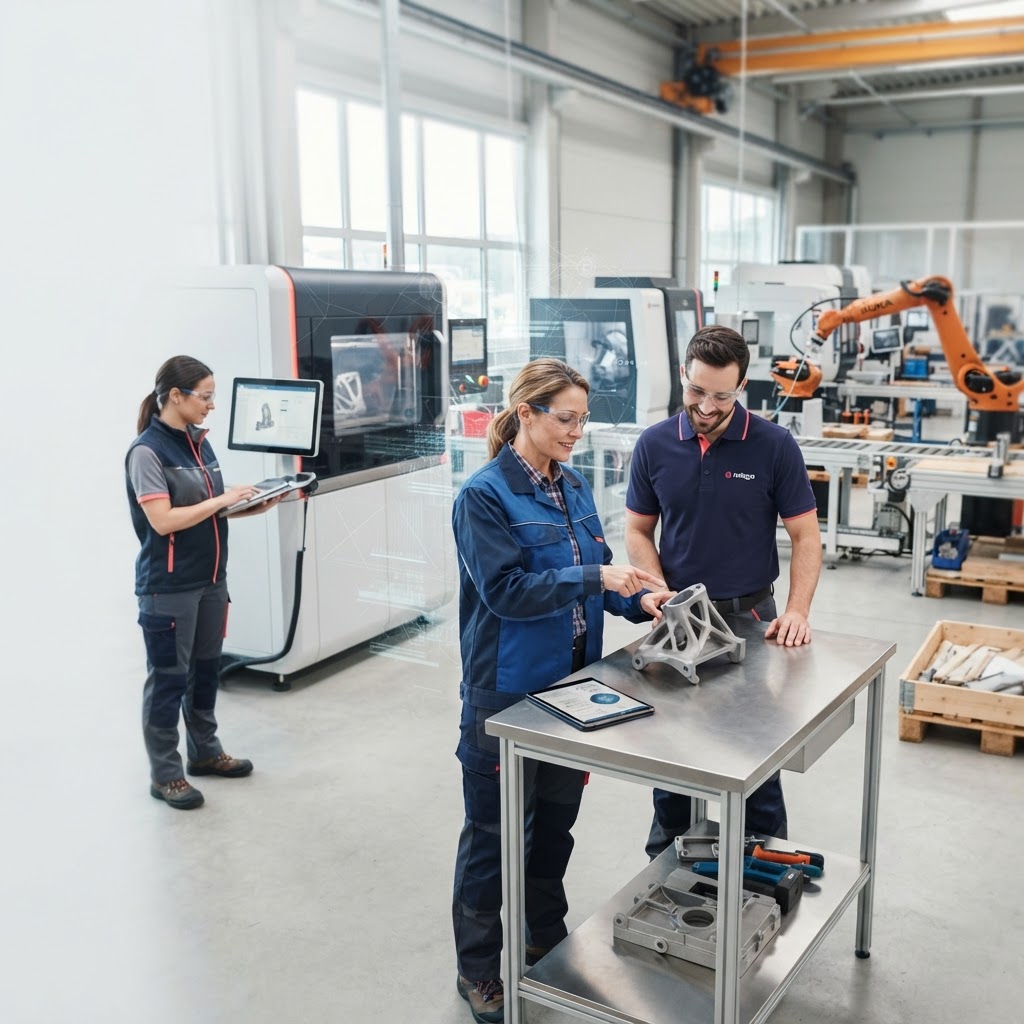
For procurement leaders and manufacturing executives, the decision to invest in additive manufacturing (3D printing) infrastructure or rely on external service bureaus is rarely binary. It is a strategic pivot point that impacts Total Cost of Ownership (TCO), supply chain agility, and quality control. As 3D printing transitions from a rapid-prototyping tool to a production-grade industrial process, firms must reconcile the capital expenditure (CapEx) of high-end machinery with the operational expenditure (OpEx) of outsourced, on-demand manufacturing services. At SoftwareVerdict, our research suggests that while in-house capabilities provide unmatched latency advantages, the "hidden" costs of post-processing, material qualification, and skilled labor often tip the scales in favor of hybrid sourcing models.
The TCO Landscape: Hidden Costs in Additive Manufacturing
When evaluating the financial viability of in-house 3D printing, procurement teams often fall into the trap of analyzing only the machine's acquisition cost. However, the true Total Cost of Ownership (TCO) in an industrial setting encompasses a much broader ecosystem of requirements. According to research from McKinsey & Company on industrial additive manufacturing, machine depreciation represents only about 20% to 30% of the total part cost. The remainder is consumed by material costs, energy, specialized labor, and—most significantly—post-processing and quality assurance.
To perform a rigorous cost-benefit analysis, organizations must account for the following categories:
- Equipment Capital Expenditure: The purchase price of industrial-grade printers (e.g., Selective Laser Sintering or Direct Metal Laser Sintering) and the necessary auxiliary hardware (powder handling, build chamber prep).
- Post-Processing Infrastructure: CNC machining, heat treatment, surface finishing, and chemical cleaning stations are often required to meet industrial tolerance standards, yet these are frequently excluded from early budget models.
- Compliance and Environmental Controls: Adhering to standards such as ISO/ASTM 52900 requires climate-controlled environments and stringent safety protocols for handling hazardous metal powders.
- Skilled Labor and Training: The current talent gap in additive manufacturing means that recruiting and training specialized technicians often carries a significant premium.
"While the barrier to entry for desktop-grade 3D printing is low, the journey to industrial-grade, certified production requires an investment in quality management systems that can easily rival the costs of traditional CNC shop floor infrastructure." — SoftwareVerdict Procurement Research Unit
Strategic Drivers for In-House Capabilities
Investing in in-house infrastructure is generally recommended when the primary value driver is time-to-market or the protection of intellectual property (IP). In sectors such as aerospace and medical device manufacturing, maintaining a "digital inventory" where files are stored centrally and printed locally is a hedge against supply chain volatility.
The primary advantage of in-house printing is the feedback loop. When engineering teams have immediate access to printing hardware, the iteration cycle for R&D is reduced from weeks—waiting for outsourced parts—to hours. Furthermore, for highly sensitive components where trade secrets or ITAR (International Traffic in Arms Regulations) compliance are paramount, keeping production behind the corporate firewall eliminates the risks associated with third-party data transmission and external fabrication.
Evaluating the Outsourcing Model
Outsourcing to a service bureau offers a vastly different risk profile. By leveraging an external partner, a company offloads the technical debt of equipment maintenance and material volatility. Service bureaus benefit from high utilization rates; a single professional service firm may run its printers 24/7, effectively amortizing the machine costs across thousands of clients. According to a Gartner industry report, firms that utilize external additive service providers for low-to-medium volume production typically report a 15-20% reduction in per-part cost compared to underutilized, internal, mid-range industrial units.
However, outsourcing involves its own set of trade-offs:
- Supply Chain Dependency: You become beholden to the service bureau’s lead times and capacity, which can be disrupted by global market spikes or local logistics failures.
- IP Exposure: While service bureaus sign robust NDAs, the transfer of sensitive CAD files and the inherent risks of data exfiltration remain a concern for companies dealing in high-security defense or proprietary high-tech designs.
- Quality Variability: Without internal oversight, maintaining consistent mechanical properties across different batches from an external provider requires rigorous vendor auditing and stringent incoming quality control (IQC) protocols.
The Hybrid Framework: A Balanced Sourcing Strategy
Most mature manufacturing organizations are moving toward a hybrid strategy. This involves keeping prototyping and rapid-turnaround, low-complexity parts in-house, while offloading high-volume or geometrically complex production runs to specialized external vendors. This model acknowledges that no single entity can excel at every material or process type.
When assessing vendors, SoftwareVerdict recommends utilizing the NIST (National Institute of Standards and Technology) additive manufacturing framework as a benchmark for quality assurance. Procurement teams should mandate that vendors provide documentation on machine calibration, material traceability (powder recycling counts), and standardized testing procedures (tensile/fatigue testing). Trust is built not on vendor promises, but on verifiable data integrity within their production pipeline.
Transparency Note: This analysis is intended for informational purposes and does not constitute financial advice. SoftwareVerdict has no commercial partnerships with additive manufacturing hardware vendors. Our recommendations are derived from empirical procurement data and industry standard benchmarks for operational efficiency.
Implementation Challenges and Future Outlook
The decision to build versus buy is further complicated by the rapid pace of technological obsolescence. High-end industrial printers often have a functional lifespan of 5-7 years before the cost of service contracts and material compatibility issues make them uncompetitive. When you outsource, your provider assumes the burden of technology refreshes; when you print in-house, your procurement department must account for periodic "technological refresh" cycles in your long-term capital plan.
Ultimately, the most successful implementations are those that align the manufacturing method with the business goal. If the objective is to build a competitive moat through secret, rapid design innovation, the higher costs of in-house capabilities are a strategic investment. If the objective is to optimize the cost-per-part of mature products, the economies of scale offered by global service bureaus are difficult to ignore.
Conclusion
The choice between in-house 3D printing and outsourcing is less about technology and more about the maturity of your procurement strategy. Organizations that treat 3D printing as a simple capital purchase often face unforeseen "hidden" costs, whereas those that adopt a holistic TCO perspective are better positioned to integrate additive manufacturing into their supply chains effectively.
For leaders tasked with making this decision, we recommend starting with a pilot program—benchmark your most frequently outsourced parts against a potential in-house configuration, factoring in not just the machine and powder, but the labor and compliance burdens described in this report. If your volume requirements are unpredictable, the flexibility of the outsourcing model remains the safer, more cost-effective choice.
Ready to optimize your procurement strategy? If you are evaluating a move toward additive manufacturing or looking to rationalize your current vendor landscape, download our "Additive Manufacturing Procurement Audit Checklist" or contact the SoftwareVerdict research team for a custom sourcing analysis tailored to your organization’s specific production volume and technical requirements.