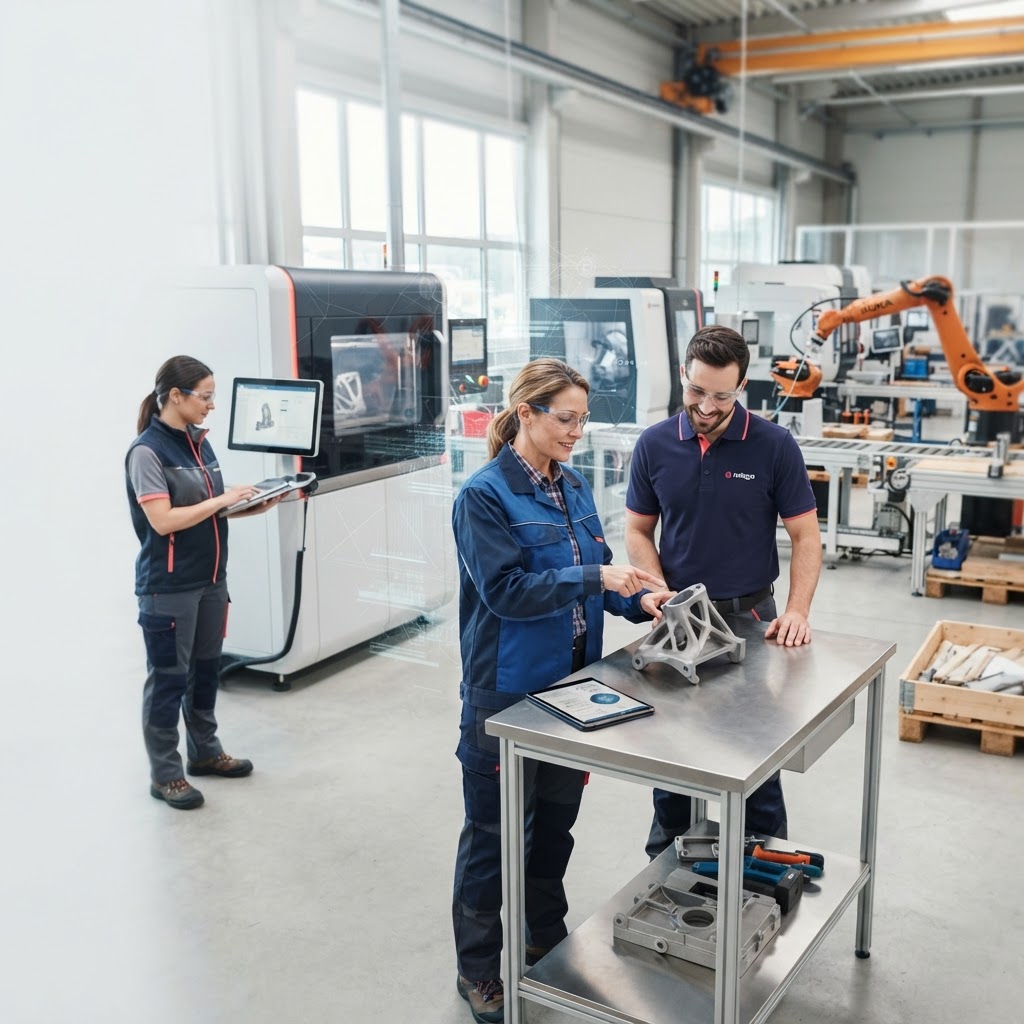
For decades, additive manufacturing (AM)—commonly known as 3D printing—was relegated to the domain of rapid prototyping. However, the paradigm has shifted. Today, enterprise-grade AM has matured into a viable production technology, enabling on-demand supply chains and complex part consolidation. Yet, the leap from a high-fidelity prototype on an engineer’s desk to a full-scale, serialized production floor is fraught with procurement complexity. As organizations transition from internal experimentation to industrial-scale adoption, the bottleneck is rarely the technology itself; it is the strategic sourcing, vendor management, and digital infrastructure required to sustain it. At SoftwareVerdict, our research indicates that procurement teams are increasingly serving as the architects of this transformation, tasked with balancing high-performance technical requirements against the need for resilient, cost-effective global supply chains.
The Evolution of Procurement in the 3D Ecosystem
The traditional procurement model, predicated on long-lead-time injection molding and subtractive CNC machining, is fundamentally ill-suited for the dynamic, software-defined nature of additive manufacturing. When sourcing 3D printed parts, procurement professionals are not just buying a physical component; they are buying a digital recipe, a material certification, and a repeatability guarantee.
According to research from McKinsey & Company, companies that successfully scale additive manufacturing integrate procurement teams early in the design-for-additive-manufacturing (DfAM) process. This early involvement allows procurement to move beyond simple "cost-per-part" analysis toward "total cost of ownership" (TCO) models. Unlike traditional manufacturing, where economies of scale are achieved through high-volume tooling investments, AM provides an economic advantage through reduced inventory costs, digital warehousing, and the elimination of complex assembly steps through part consolidation.
Key Strategic Shifts for Sourcing Teams:
- Transition from Transactional to Strategic Sourcing: Shift focus from selecting vendors based on unit price to evaluating their digital capabilities, quality management systems (QMS), and connectivity to enterprise ERP/PLM platforms.
- Digital Warehousing: Procurement must now account for the "cost of bytes" over "cost of boxes." Storing digital design files securely requires investments in cybersecurity and intellectual property management.
- Quality Assurance at Scale: Move away from traditional "first-article inspection" for every batch toward "in-situ monitoring" and statistical process control (SPC) data provided by the printer manufacturer.
"As we observe the market shift toward industrial 3D printing, the most successful organizations are those that treat their additive vendors as technology partners rather than commodity suppliers. Data transparency, specifically regarding material batch consistency and build-file provenance, is now the new currency of industrial procurement." — SoftwareVerdict Research Analysis.
Navigating the Complexity of Material and Vendor Qualification
One of the most persistent challenges in scaling AM is the lack of standardized material properties. Unlike the mature standards provided by ASTM or ISO for traditional alloys and polymers, additive materials are highly sensitive to the specific printer architecture, chamber temperature, and post-processing methods. This poses a significant risk to supply chain continuity.
Enterprise procurement departments must adopt rigorous qualification frameworks to mitigate these risks. Following ISO/ASTM 52900 standards for additive manufacturing terminology and process categories is no longer optional; it is the baseline for contractual compliance. Furthermore, when selecting service bureaus or internal printer OEMs, procurement must demand evidence of compliance with standards like AS9100 (for aerospace) or ISO 13485 (for medical devices), which require strict traceability of powder lots and build logs.
The trade-off here is speed versus rigor. Implementing a robust qualification process often adds weeks to the procurement cycle. However, as noted in Gartner’s *Hype Cycle for 3D Printing*, firms that shortcut these processes often face significant yield losses once they reach serialized production volumes, essentially negating any cost savings gained during the procurement phase.
The "Digital Thread" and Data Integrity Requirements
Scaling additive manufacturing requires a seamless "digital thread"—the integration of CAD models, simulation data, and printer machine code into the enterprise Resource Planning (ERP) system. SoftwareVerdict’s analysis indicates that procurement teams are increasingly responsible for verifying that vendors can provide end-to-end data integration.
Essential Capabilities for Modern Additive Suppliers:
- ERP/PLM Integration: Does the vendor’s production environment automatically pull data from your internal product lifecycle management system?
- Cybersecurity Frameworks: With the rise of industrial espionage, ensuring that your CAD files and proprietary print parameters are stored in a NIST SP 800-171 or CMMC-compliant environment is critical for defense and regulated industry contractors.
- Build Reporting: Can the vendor provide a comprehensive "birth certificate" for each part, including laser power logs, oxygen levels, and build plate temperature fluctuations?
Ignoring these digital requirements is a common pitfall. Procurement often focuses on the physical inspection of the part, overlooking the fact that in additive manufacturing, the part's integrity is defined by the process data. If the data is missing, the part is essentially "unproven" from a regulatory standpoint, regardless of how well it performs in bench testing.
Addressing Trade-offs: The Limitations of Additive at Scale
While the benefits of AM are substantial, it is crucial for procurement leaders to maintain a balanced perspective. Additive manufacturing is not a silver bullet. The trade-offs often center on material throughput and post-processing requirements.
In many enterprise use cases, post-processing (such as support removal, heat treatment, surface finishing, and inspection) can account for up to 60% of the total part cost. When sourcing from external partners, procurement teams must ensure that these "invisible" costs are clearly defined in the Statement of Work (SOW). Failing to define the surface roughness requirements or the tolerance limits for post-machining can lead to significant cost overruns and production delays.
Furthermore, scaling AM creates a reliance on niche talent. Finding a vendor with deep expertise in specific modalities like Selective Laser Melting (SLM) or Directed Energy Deposition (DED) is harder than finding a general CNC machine shop. This scarcity of expertise often results in higher pricing models, which must be offset by the design-level benefits, such as weight reduction or improved fuel efficiency in the final product.
Conclusion: Building a Future-Ready Procurement Strategy
The transition toward industrial additive manufacturing is as much a digital and cultural shift as it is a manufacturing one. To move from the pilot phase to global enterprise scale, procurement leaders must move away from the traditional role of "cost-controller" and evolve into "value-chain architects." This involves prioritizing data transparency, rigorous vendor qualification against global standards, and early-stage collaboration with design engineering teams.
As you navigate this transformation, remember that your procurement strategy is the foundational layer of your supply chain’s resilience. By leveraging the right software tools and adhering to established industry standards, your organization can harness the true potential of 3D printing, turning a prototyping novelty into a strategic competitive advantage.
Transparency Note: This article reflects research conducted by SoftwareVerdict. Our insights are derived from independent data analysis and do not constitute an endorsement of any specific hardware vendor or software platform. Procurement decisions should always involve cross-functional consultation with your internal engineering and quality compliance teams.
Are you ready to optimize your additive supply chain? Download our latest Procurement Intelligence Report to compare vendor capabilities and benchmark your internal additive maturity against industry leaders.