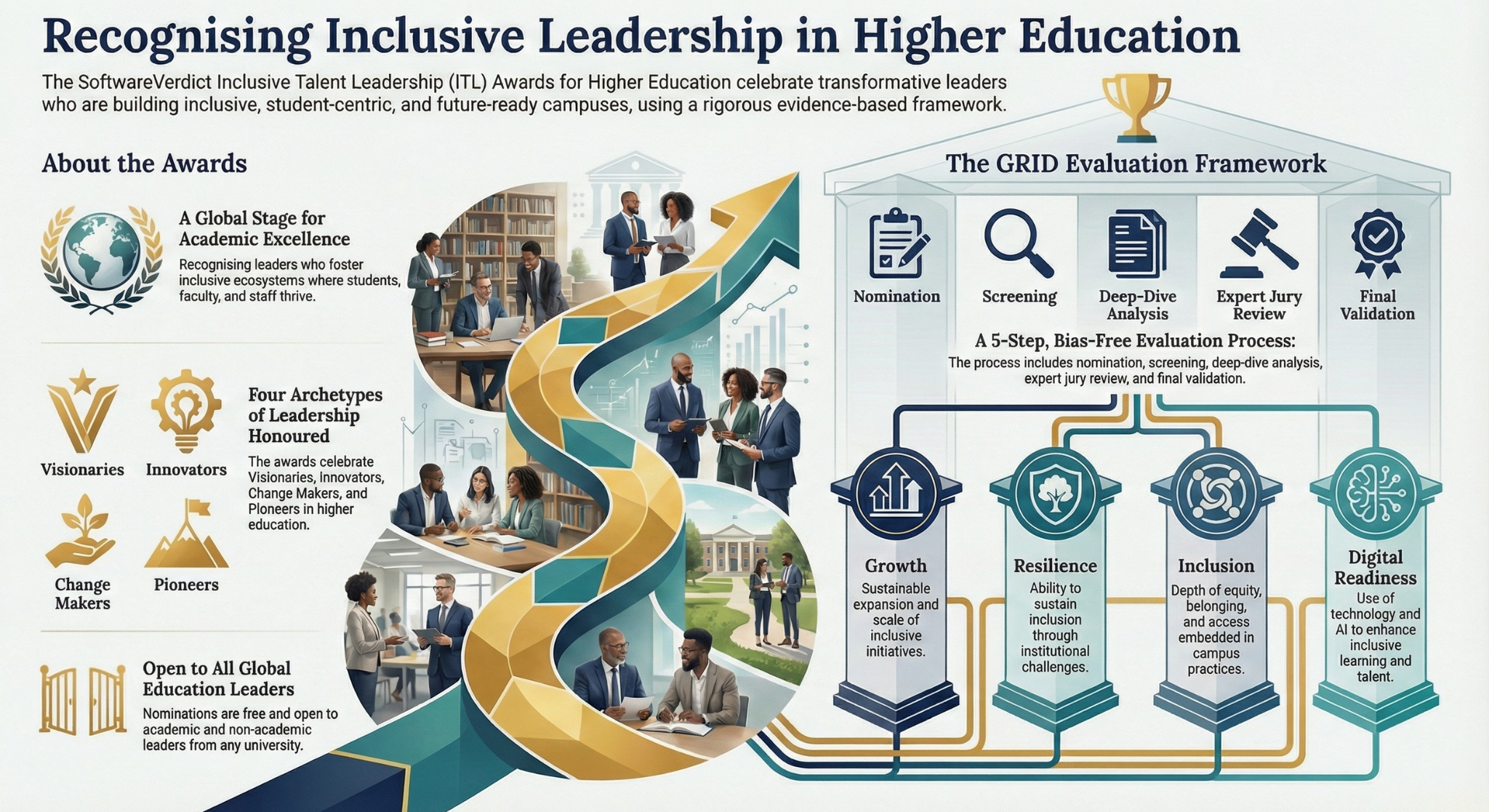
The Higher Education edition of the Inclusive Talent Leadership (ITL) Awards follows SoftwareVerdict’s proprietary GRID Framework—a structured, research‑driven approach adapted for academic and institutional leadership. This ensures transparency, fairness and focus on real impact in inclusive talent practices.
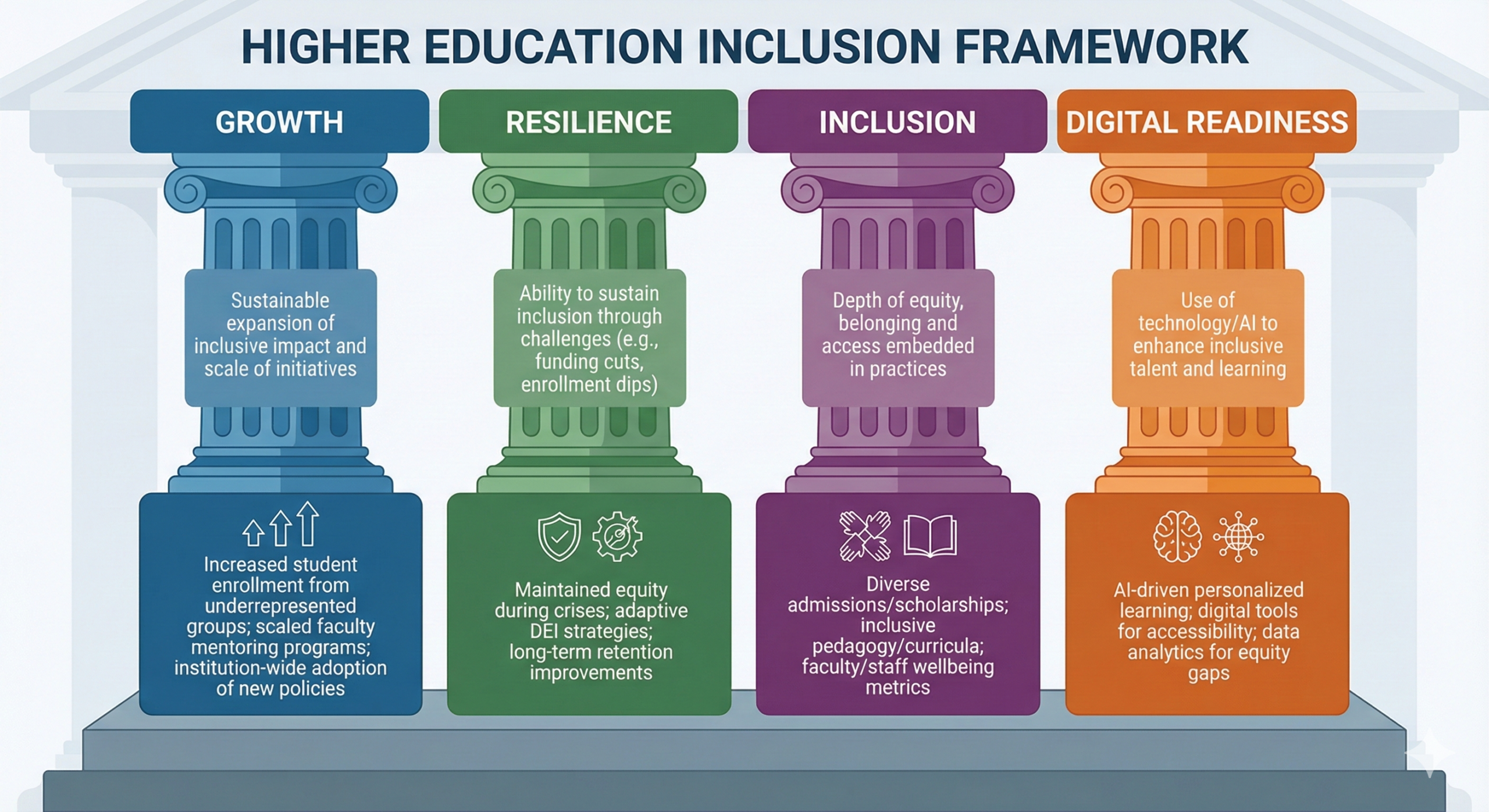
SoftwareVerdict’s GRID Framework evaluates Higher Education leaders across four pillars, each weighted equally (25%)
| Pillar | Description | Higher Ed Examples |
| Growth | Sustainable expansion of inclusive impact and scale of initiatives | Increased student enrollment from underrepresented groups; scaled faculty mentoring programs; institution‑wide adoption of new policies |
| Resilience | Ability to sustain inclusion through challenges (e.g., funding cuts, enrollment dips) | Maintained equity during crises; adaptive DEI strategies; long‑term retention improvements |
| Inclusion | Depth of equity, belonging and access embedded in practices | Diverse admissions/scholarships; inclusive pedagogy/curricula; faculty/staff wellbeing metrics |
| Digital Readiness | Use of technology/AI to enhance inclusive talent and learning | AI‑driven personalized learning; digital tools for accessibility; data analytics for equity gaps |
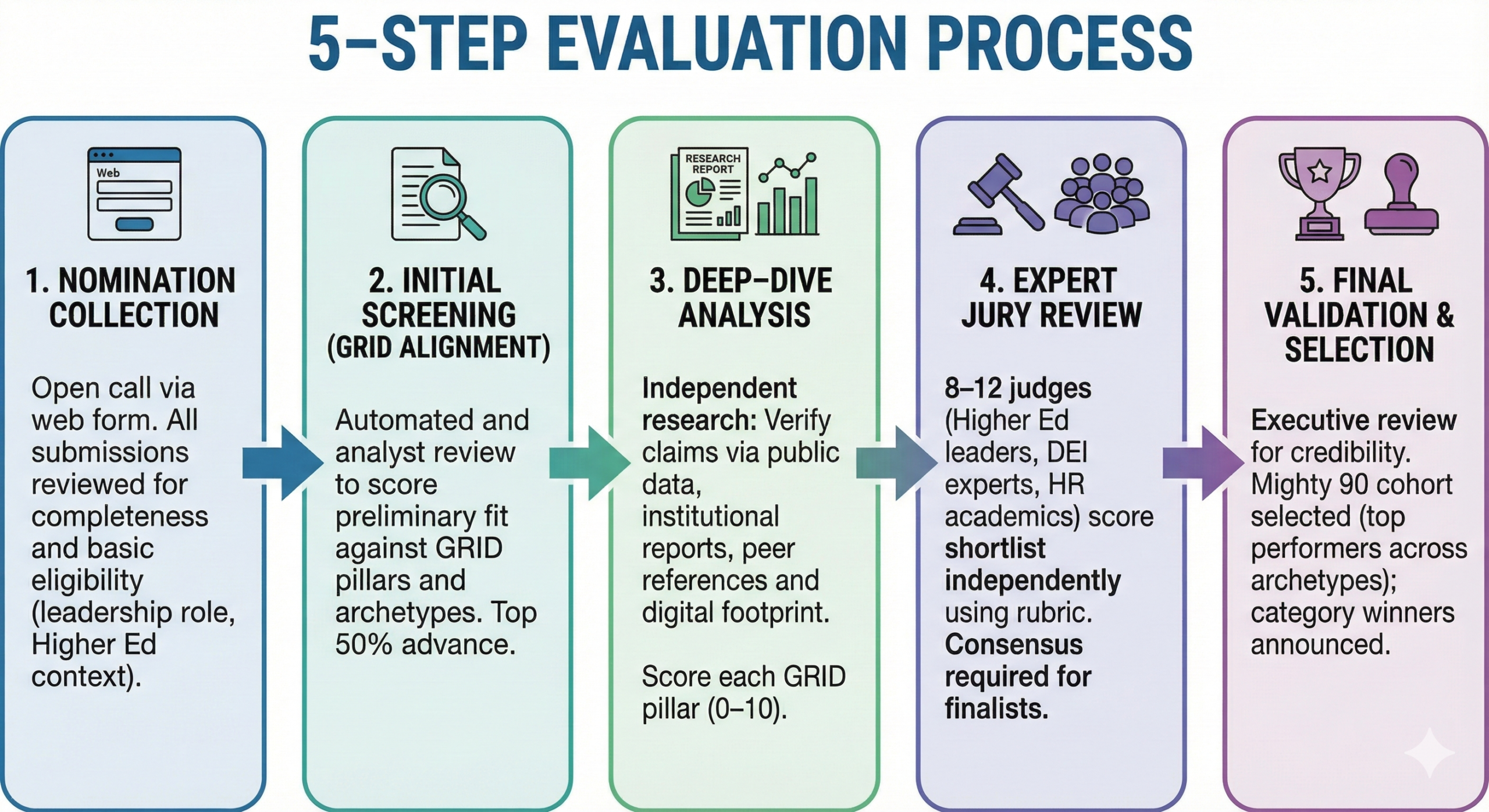
All declare conflicts of interest; scoring is blinded initially.
Total Score: Average of GRID pillars + archetype bonus (up to +2 for perfect fit).
SoftwareVerdict is a global research and decision intelligence platform that empowers leaders to make smarter choices in technology, talent and strategy. Through its independent research, software marketplace and leadership recognition programs, SoftwareVerdict has become a trusted partner for over 1,700+ software solutions and thousands of enterprises worldwide.
The Inclusive Talent Leadership (ITL) Awards, flagship initiative of SoftwareVerdict, celebrate leaders who are redefining workplaces through equity, inclusion and people‑first innovation. Launched to recognize HR and talent professionals driving the future of work, ITL has grown into a global benchmark, spotlighting the Mighty 90 cohort each year—90 exceptional leaders grouped across four archetypes: Visionaries, Innovators, Change Makers and Pioneers.
Now, SoftwareVerdict introduces the ITL Awards for Higher Education Leaders, a dedicated edition that brings the same rigorous methodology to university and college ecosystems. Higher Education is the ultimate talent incubator, shaping students, researchers and faculty who power economies and societies. Yet, inclusive leadership in academia—removing access barriers, fostering belonging, scaling mentorship, and blending tradition with digital innovation—deserves its own stage.
This edition honors Vice Chancellors envisioning equitable campuses, Deans pioneering hybrid learning models, Registrars streamlining student journeys, and emerging Heads of Department building departmental cultures of inclusion. Using the proprietary GRID Framework (Growth, Resilience, Inclusion, Digital Readiness), nominations are evaluated transparently by a jury of Higher Ed experts, HR leaders and researchers.
Winners join an elite global network, gaining visibility through SoftwareVerdict’s platforms, digital badges, case studies and peer communities. In an era where universities must compete for diverse talent while adapting to AI and lifelong learning, the Higher Education ITL Awards position institutions as leaders in inclusive excellence.
Share on



© 2026 SoftwareVerdict | All rights reserved
SoftwareVerdict and its logo are trademarks of SoftwareVerdict.